Yesterday, I had a call with a company that has only been around for about 9 months. I walked through a demo on how to use their search engine, in which they claim MSN stole their algorithm. I was surprisingly impressed with this search engine that I honestly had never used before. It’s called LeapFish. And no, they’re not paying me to blog about them.
I feel LeapFish is an up-and-coming search engine that may truly find itself competing with the big dogs. What’s cool about them is that you can search for a keyword in Google, and with a click of a mouse you can search in Yahoo and MSN for the same keyword. It’s fast, really fast and very user friendly.
If you type in a city name with a space, then the state, sometimes in the right hand navigation they’ll give you local results for real estate, or restaurants if you type in ‘pizza san Francisco CA’.
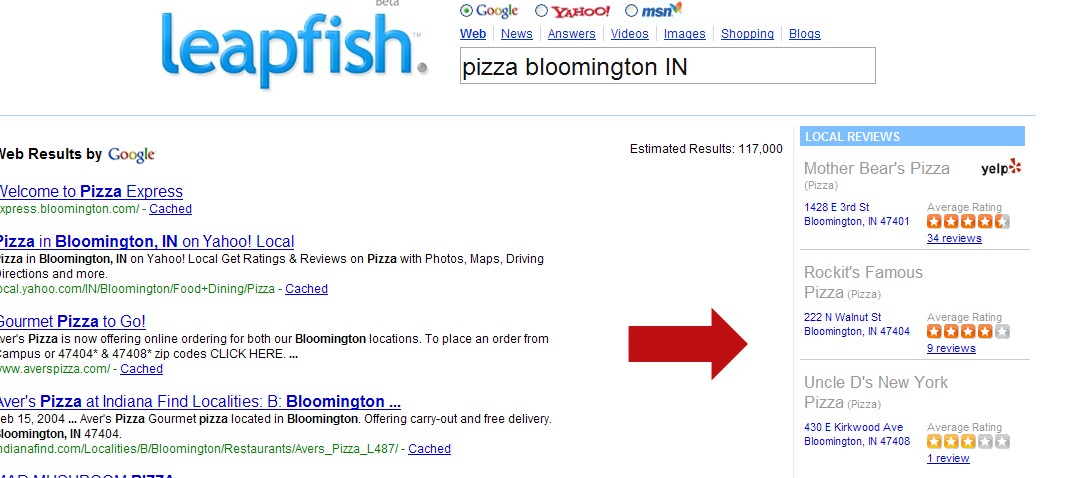
You can also click to see different kinds of results for your keyword search like information on the web, news, answers which are powered by Yahoo, videos, images, shopping and even blogs.
One other thing the rep told me, was that if you type in your company url into their search, again off to the right hand side it will give you domain information for that company including how much their domain is appraised at, how many unique visitors, traffic ranking and a graph that shows peaks and valleys of traffic. Very cool.
A different kind of PPC advertising:
Now, about their paid search program which I found to be of most important and very useful for advertisers. When the internet began to get popular, people started buying popular domain names of companies who could later sell those domains to the companies and make a large profit. The same thing could and is going on here at LeapFish. People are buying keywords off Leapfish now, and plan to sell them later when Leapfish gets bigger. As Leapfish gets bigger, and as the keywords become more competitive, the keywords will increase in value, and can sell for a much higher price than what you’ll be paying for now.
Their PPC advertising program is not like Google, Yahoo or MSN. You don’t pay for each click or pay any monthly fees. You buy keywords permanently. LeapFish offers 3 paid positions for each keyword search result. You can buy to be in position 1, 2 or 3 and each have a different price for that particular keyword. When you buy these keywords, they’re yours for life, at least until you sell them off to another company willing to pay you premium cash for them. You also maintain your number 1, 2 or 3 positions in the SERPs for that keyword for life. This will never go away until you sell your keyword. The paid ads are located at the top of each SERP and at the very bottom of each page.
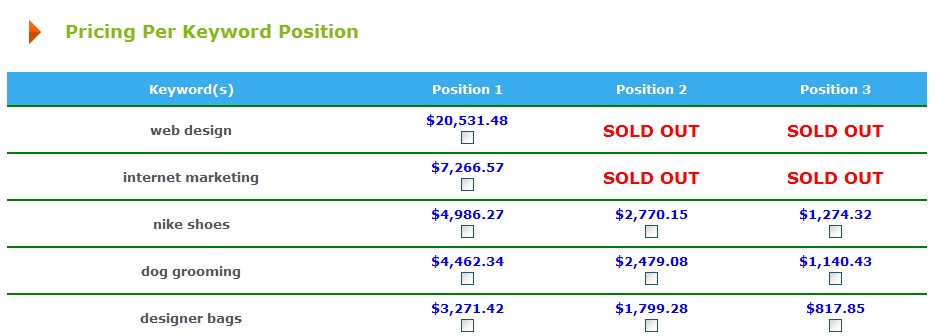
I will say that some competitive keywords are not cheap. Looking up some keywords for a client of mine I found position 1 to charge around $5,000. But if you think about it, this is really all you have to pay for a paid ad in that keywords SERP. Sort of. In addition to the one-time purchase of the keyword, you are also charged a yearly 5% fee of your keyword spend. So if you buy just one keyword and pay $5,000 for it, you’ll be charged $250 annually. Not bad when you think about it long term. Just to give you an idea of their pricing structure I’ve typed in a few keywords to get estimates on. See screen shot below on the range you could be paying to have permanent placement on Leapfish.com
This brings me to my next point. This is a long-term strategy. This is not for small business’s wanting to teach themselves PPC advertising for a month to see how it works. As far as reporting, you can add in add tracking to your destination URLs and \ track Leapfish visits and leads via Google Analytics.
Another good thing LeapFish is doing to get the word out about themselves is sponsoring many national search engine strategy conferences. They’ve been featured in several high profile websites. Their CEO, who is only 29, by the way, and has been recognized as one in the top 40 Silicon Valley innovators.
I think this is something every company big or small should be looking into right now. Leapfish is still in Beta, but I believe it will be officially live in October 2009.
Is anyone currently buying keywords from Leapfish? If so, is it working for you? What are the positives and negatives?


This article doesn’t seem to mention the past allegations of click fraud against Leapfish employees or their high pressure and often controversial sales process.
Why would I bother using Leapfish if they’re just going to syndicate (primarily) Google’s results? I’m happy w/ Google and don’t need to visit another site to see the same results. Google’s ad results are also pretty useful most of the time…I think their quality-based model has a lot to do with this. If Leapfish grows, I think the paid placement model will ultimately hurt them….as a user, I wouldn’t put much trust in the overall results if Big Brand 1, 2, & 3 are the only ones represented. Or, looking at it a different way, if Acai Berry, Fatloss, & Ringtone ads are everywhere b/c affiliates infiltrated then engine first.
Domain name info is interesting (IF you play in the IM space), but the mass market really doesn’t care about this. IMO, Leapfish looks & smells a lot like Dogpile (which never was able to grab much mkt share). Maybe I’m wrong, but I personally just don’t see much value added in a metasearch engine like this. I’ll stick w/ G, thanks.
Seems to me that this is a complete gamble with your money.
Too much risk to spend 3 – 10 k on.
The values they assign to keywords seem a bit random to me. I tried a few keywords with roughly the same number of searches on Google. Prices on Leapfish varied wildly. What do they base the value of a keyword on??
Their whole value proposition rest on what you call ‘As Leapfish gets bigger, and as the keywords become more competitive, the keywords will increase in value, and can sell for a much higher price than what you’ll be paying for now.’ What if they don’t become bigger? Spending several thousand per keyword sound like a bad bet to me.
But my most important complaint about this idea. Searchers use wildly different searchterms to find the same thing. I have thousand and thousands of keywords in my campaigns. Even buying a fraction of those keywords is gonna cost me an insane amount of money.
I find it more interesting that they’re claiming that MSN stole their algorithm and that they’re telling potential clients that. It seems “fishy.” Did they offer any proof?
This is a great rundown though on the company, I’ll be keeping an eye out for future developments, thanks!
Just one problem with all of this. There is no guarantee of clicks. You just drop 3K – 10K and cross your fingers. Hmmm. What if I get 300 clicks and 2 leads over the next year at a CPL of $2500?
Like @Garret said, this just doesn’t seem like a good business module that expects to grow significantly. Conclusion, they’re not going to grow significantly. There are plenty of other PPC plays out there. I’m passing on LeapFish.
This sounds like a Real Keywords-type toolbar scam. These bogus deals have been around for years. I’d run as fast a I could.
I don’t see anyone using this engine besides SEOs wanting to quickly comparing competitor rankings vs. they’re own rankings in the major 3 engines. However, you can use SEO Open’s Rank Checker tool to easily get ranking data.
I do think it’s a very interesting PPC model. I wonder what would happen if Google offered this PPC model?
I was contacted by a Leapfish rep, and the whole thing smelled very fishy. When I asked questions that the initial rep couldn’t answer, I was quickly transfered to a “closer”. They played up the up-and-coming angle to me as well, and their proof was an Alexa rank of 19,000. They quoted me a price of $6,000 for the keyword phrase “motivational speakers” at a number 3 position. Yeah, right – like I’m going to spend that kind of money for paid advertising on a META search tool that has an Alexa rank of 19,000! Let’s see – Google’s Alexa rank is 1, Yahoo! is 2, Bing is 22. It’s rediculously speculative to think that the world is beating a path to Leapfish.
I fully investigated this about a year ago, had their account managers trying to close me for months.
There’s no future here. It’s a aggregator of which there have been many before it and will be many after it.
Plus, there’s allegedly a lot of shadey stuff going on behind the scenes there.
IMHO, you will get a LOT more for your $5k using a well designed AdWords campaign. That would pay for exactly two years of AdWords for what I’m currently doing.
RM
It is definitely an interesting take on PPC but there are too many loopholes out there for me to feel that this would be something I would recommend to a client. Somewhat in their defense, they have seemed to take a Google approach (Google turning branded keyword PPC buying into the wild west) and say here is the keyword, its up to you to buy it. The other problem is that essentially he who has the most money wins which isn’t good for small to medium business (which automatically limits your audience and even users). After seeing some of the previous comments I checked out the allegations and I don’t see how anybody could feel comfortable with purchasing PPC ads from Leapfish. Good post and is definitely thought provoking.
I agree with Eric – there are just too many unknowns here.