
Dealing With Google AdWords and Analytics Data Discrepancies

A few months ago I wrote a guest post for Portent Interactive about the data discrepancies between Google AdWords and Analytics. It’s still something I deal with every day when trying to analyze and make account decisions and I wanted to share this post with our readers.

In a touching speech by President Jack Nicholson, he asks alien invaders “Why can’t we work out our differences? Why can’t we work things out? Little people, why can’t we all just get along?” Although things didn’t end so well for him, this is often how I feel about the relationship between AdWords and Analytics. They both provide excellent information that is extremely valuable to anyone managing a PPC account, so why oh why can’t they just get along.

Last week I was hit head on with the data discrepancies between the two interfaces when I went to implement ad scheduling for an E-Commerce client. I wanted to analyze hourly performance to determine if there were times throughout the day when we could either reduce bids or pause ads to better utilize our budget. Sounds easy enough right?

I first downloaded conversions by hour in AdWords. Below is a screenshot of the results:
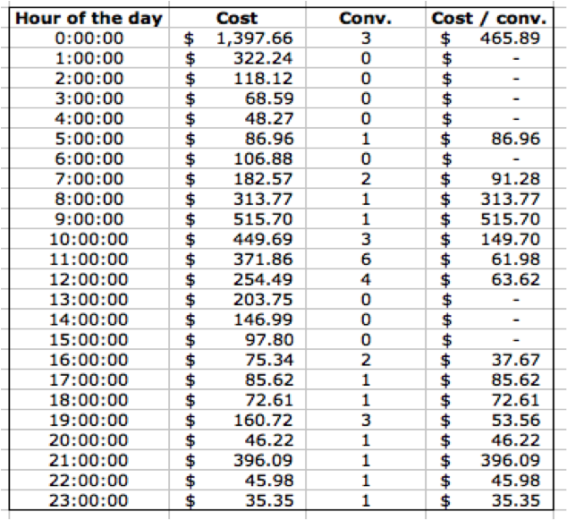
AdWords Conversions

The account is spending the majority of its budget at 12am, at a cost per conversion of $465.89. This amount seems high, especially compared with other hours of the day, but I wanted to know the value of these conversions before I made any decisions. I pulled revenue data by hour from analytics to calculate ROI and this is where things got interesting:
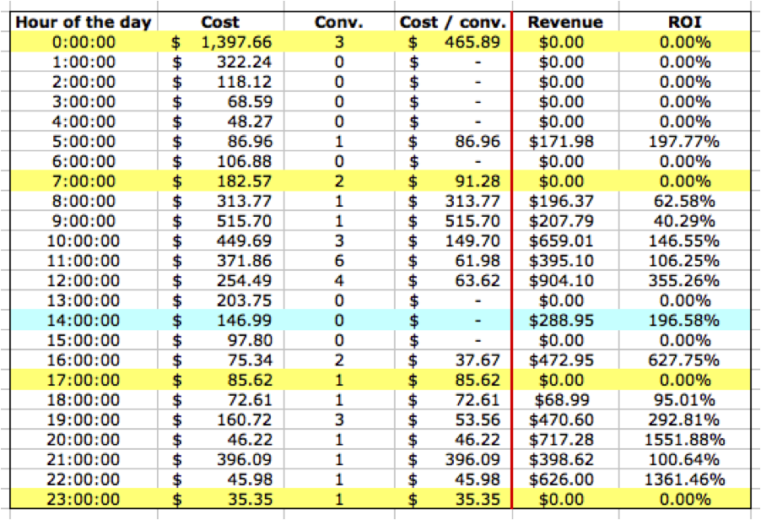
Analytics Revenue

The rows highlighted in yellow are hours in which AdWords recorded conversions, but no revenue was generated. The row highlighted in blue is when AdWords recorded no conversions, but the account brought in almost $300.

This discrepancy is due to the difference in how AdWords and Analytics attribute conversions. AdWords assigns conversions using first click attribution whereas Analytics uses last click attribution. For example, lets say a person clicked on one of our PPC ads, viewed our products, went to a competing site to compare prices, then came back to make a purchase by typing our website into the search bar. AdWords would attribute the conversion to the time the PPC ad was clicked. Analytics however would attribute it as a direct goal conversion.

This is where I had to look at the whole picture and start making some decisions. We were spending a lot of money at 12am, but I didn’t want to completely turn off ads at this time.  Some of those clicks were turning into conversions at some point throughout the day. I just wasn’t able to tie this information to revenue Analytics.

Ultimately I decided to decrease bids during hours with a high cost per conversion, whether revenue was generated or not. I only turned off ads during times when no conversions or revenue was reported. I also decreased bids for any hours where revenue was less than cost. Bids were left at 100% for all other hours of the day.

Even though AdWords and Analytics data will never match up, it is important to look at both before making account decisions. Using just one or the other only shows you a part of account performance. Maybe one day these two will learn to get along but until then we will have to use the data available and our best judgment when making changes to our PPC accounts.

About the Author

Bethany Bey

Bethany is a former Account Executive at Hanapin Marketing, a search engine marketing firm focused on generating results through pay-per-click advertising.
  • christopher

    This is definitely an interesting analysis but it looks like the data was rather thin (not statistically significant enough) to be using as a basis for ad scheduling decisions. 

  • Pingback: Dealing With Google AdWords and Analytics Data Discrepancies | Iuvo

  • Pingback: Google AdWords and Analytics Data Discrepancies | The Adventures … | How To Start Online Business

  • Mark Traphagen

    What we find disconcerting is the rather huge discrepancies, at times, between number of conversions and amount of revenue generated between AdWords and Analytics, and we see this not just for a single day as in this example but over long stretches of time. We used to tell clients “the important thing is the overall trends, not the details,” but that doesn’t hold up when sometimes we see trends go in opposite directions!

  • Pingback: Why are There Conversion Discrepancies Between Google AdWords and Analytics? | Virante Orange Juice

  • Pingback: Analizando los informes de conversiones de Adwords | Enrique del Valle

  • Saija

    I have the same issue and not sure exactly how to satisfy the customer? It would be easy to pick the ‘better’ results, but then again we should be transparent and accurate on our reporting and I don’t really want to have to report on both and analyse both when they should really be seamless, working together.

  • Pingback: sony playstation vita

  • Steve

    Are you certain this is the case? I’m was under the impression that Analytics would not overwrite the attribution when the traffic source was overwritten by Direct.

  • Pingback: PPC Toolkit: Resources for Improving Your PPC Accounts | PPC Marketing Advice

  • Marktristan

    Hey Bethany, interesting post. Just to clarify:

    - Are you talking about differences between AdWords Conversion Tracking (based on destination pages) and GA conversions (ecommerce transactions + goals defined various ways)

    - Or are you saying that AdWords will count conversions on a different basis even if the conversions used in AdWords are those imported from GA?

    • http://www.hanapinmarketing.com Bethany Bey

      Great question. I’m referring to the same conversion that is being tracked differently by AdWords and Analytics. In AdWords, the conversion was being assigned to when the click on the ad occurred and in Analytics to the time the actual conversion occurred. Since this was a longer buying cycle product, those two were often very different.

  • http://www.imsoftwaredevelopment.com/internet-marketing-services/seo-services.html SEO Services

    Really you have made good combination with google adwords & analytics, your whole article information is useful for me.

  • http://www.facebook.com/smith.bill1 Smith Bill

    your whole article information is useful for me.Please visit at 2ezasia website for magento services.

  • Fab

    I have big differencies betwwen my numbers of Adwords conversions and Analytics Goals.

    As it is on a b2b website, we noticed like 20% to 30% of goals are returning visitors. (second or third visit)

    Let me give you an example of my problem :

    If someone clicks on an Adwords Ad then in Analytics the medium is “cpc” and the Campaign is “name of Adwords Campaign”.
    Then the same user comes back later (3 days after) on the website with organic search “name of my brand” and then fill a form (goal)

    In Adwords this is for sure counted as a Conversion for the first click.

    But in Analytics, will it be a goal with Medium “Organic” or Medium “cpc” ??