
problem

3 View-through Conversion Attribution Problems

View-through conversions are conversions where a customer saw—but didn’t click— a display ad on the display network before completing a conversion. – source

Agencies and account managers want to report this, or a portion of these to their clients and bosses, but unfortunately the problem of how to give credit to these conversions always arises. Basically it revolves around, “how much are these really worth?” And, “did seeing that display ad really lead to a search and then a conversion? Or was it serendipitous?”


Problem 1: Aren’t they just duplicates of the other conversions in the interface?

Yes. Unless you de-dupe them by going to Tools and Analysis => Conversions => conversion(s) name => Advanced (tab) and Enable “View-through conversion search de-duplication
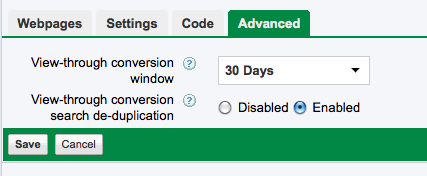
 

View Through Conversion Attribution


Selecting this option allows you to see those conversions that happened after someone say an ad on the display network, but did not click it. Then later converted through a direct visit, organic visit, or other means. This more accurately tells you how many extra conversions your AdWords campaigns are participating in other than the click-through conversions you are getting attributed to your account in the interface.


Problem 2: Did the ad on the Google Display Network (GDN) really aid in the conversion?

There’s no way to know? In some cases there probably is not. But in many cases you will likely see an increase in overall conversions (through all online channels) if you are seeing a large volume of de-duped view-through conversions.

Many solutions can be created to judge the real value/impact of the GDN ads, but one simple way is just to measure pre-GDN total conversions and post-GDN conversions. Of course, if you done other major new marketing initiatives this will skew it. So you will want to coordinate a 2-3 week test window where you attempt to leave everything else the same.

Scientific? Not hardly, but it will tip the scales in a direction to see if it’s worth doing a more structure test/measurement.

Two additional, still not scientific, ways to measure the impact is to watch conversion rates and branded impressions.

If you launch the GDN, start getting VTC’s and your conversion rates go up on other campaigns, then you can assume that the branding has assisted you be more effective with your existing campaigns.

When launch a display campaign and see that branded impressions go up, then there is a good chance that the new ads are leading to more searches on branded terms and thus you are driving view-through conversions for branded terms.


Problem 3: Even if I believe you that these are valuable, how should I weight them?

If you have de-duped your VTCs then I’d say count them 1 for 1. Of course, you and/or your client are not going to. And I get it. If it only led to a conversion down the road you’ll be double counting that conversion somewhere. So another general rule is to simply decide how much an assisted conversion is worth to you and be consistent.

Even if it’s just 10%, that’s still admitting that these conversions are worth something, because they are. For many GDN campaigns I manage, counting 10% of VTC could mean the difference between being at goal, and absolute rock star performance.


Okay, for those of you who attempt to influence decisions makers on the value of PPC/View-through conversions, what are your thoughts? How do you attribute VTCs?

About the Author

Jeff Allen

For over a decade Jeff has managed marketing campaigns for major national and international corporations. He has won awards in email marketing, and has displayed an aptitude for producing goal-exceeding results in PPC and SEO management. He attributes his successes to a gut-level determination to winning in any conditions, no excuses. Jeff graduated from the University of Utah and remains a rabid U of U football fan. He also roots the Utah Jazz, loves to fish, and enjoys being a bit of a foodie with his wife, Lori.
  • Lisa Willilams

    Thanks so much, have been working on a model for attribution, hoping something would make this a little easier;) Cheers

  • http://twitter.com/DerekOstler Derek Ostler

    have you done this with FB ads yet?

    • http://www.hanapinmarketing.com PPC Hero

      We have not. Let us know if you find anything interesting out!

  • http://twitter.com/GnosisArts Gnosis Media Group

    You’ve got somewhat of an incomplete picture here on point 1.

    You say,

    “Aren’t they just duplicates of the other conversions in the interface?”.
    “Yes. Unless you de-dupe them”

    But this is somewhat misleading. You can’t see VTCs at all if the de-duping feature is enabled, according to Adwords:

    “The data you see in your reports can be affected by how you’re
    tracking view-through conversions. Here’s how, depending on whether or
    not the feature is enabled or disabled in your account:

    Disabled: If a customer views your display ad,
    doesn’t click it, and then later clicks on a search campaign ad, we’ll
    count one view-through conversion and one click conversion.

    Enable: If a customer views your display ad,
    doesn’t click it, and then later clicks on a search ad, we’ll count only
    the last conversion type (the click conversion, for example).”

    Eric Bryant
    Gnosis Media Group

    • http://www.hanapinmarketing.com PPC Hero

      Hey Eric,

      You can still see VTCs if you enable de-duping. This feature just allows for the AdWords system to only give credit to View Throughs that aren’t counted elsewhere as other AdWords conversions. You’ll still receive credit for a VTC if someone sees a display ad then converts organically or as a referral or some other non-PPC means.

      All of Google’s double negatives can be a bit confusing, but we’ve enabled de-duplication in our campaigns and we’re still seeing plenty of them come in (just not as many).

      Thanks for helping clarify the issue!

      • http://twitter.com/GnosisArts Gnosis Media Group

        Ah ok. I get it now. (I think). So, for example, yesterday, my 3 search campaigns reported 14 1-per click conversions. My 1 GDN campaign reported 14 VTCs. I have search de-dupe disabled. So this means, really only 1 of the VTCs was non-duplicated.

        So, isn’t another simple method just to leave de-dupe disabled (so you can see all VTCs Adwords reports), then just do VTCs – Conversions 1 per click = Actual Number of VTCs to add on to the Conversions 1 per click?

        • http://www.hanapinmarketing.com PPC Hero

          Hey Eric,

          Your thinking on the pre-revised ads being responsible for the missing VTCs is on the money. If you change the view to all ads you should hopefully be able to find those other VTCs.

          The problem with doing VTCs – Conversions is that your conversions could be coming in via different campaigns and that they also come in for people who haven’t been served any display ads at all. It would be an apples and oranges comparison to some extent. So if your display campaign shows an ad to someone who then later converts via a non-branded search campaign, the display campaign gets a VTC and the search campaign gets a regular old conversion. All of the conversions could be spread out across your account, which means things can get pretty complicated.

          And there are also all of those people who just converted via search, so subtracting that conversion out of the VTC total wouldn’t be entirely accurate.

          These can get pretty complicated, so hopefully that makes sense!

      • http://twitter.com/GnosisArts Gnosis Media Group

        Now, here’s another curious aspect. My Adwords reports show 14 VTCs from the GDN campaign, but only 8 VTCs when you view the ad view??? How would you make sense of that? The period was over the weekend (May 3 – May 5) and I will say that on Saturday I changed the ads slightly, so they went back into Under Review Status. So maybe the other 6 VTCs came from the pre-revised ads?

  • Alex Czarto

    A very valuable test to run is to do an A/B test on the display network: Show your ad to 50% of the users, and a blank or PSA ad to the other 50%. Then calculate the additional lift produced by your actual ad vs the placebo.

    I did a writeup on my results here:

    http://czarto.com/2013/05/29/calculating-the-value-of-your-view-through-conversions/

    Thoughts?

    • JeffreyAllen

      That’s a great test. It sounds like AdRoll likes doing this, I wonder if Google wouldn’t view it negatively. Even if it was a PSA the link would have to go a page with relevant content. Thoughts on how to get around that?

      • http://czarto.com/ Alex Czarto

        AdRoll uses the Google network to serve it’s ads, so it seems like this sort of thing is at least somewhat acceptable by G.

        I don’t think the destination url of the display ad matters: We are testing the effectiveness of View Through Conversions or if the “eyeball” helped trigger a conversions (the click would count towards CTC). So even if the click goes to a different site, if that same user ends up converting on YOUR site a few days later the VTC should still get triggered and counted towards the PSA.

        It’s a little confusing, but the PSA ad is tracking “false positive” VTCs (one would assume that CTCs on the PSA ad would always be zero since it goes to a different site)